
“Why Trump believes in negative thinking and how it may determine the approach to the Ukrainian-Russian negotiations in the coming weeks.”, — write: www.pravda.com.ua
Should these principles be followed in the context of a potential peace agreement?
There can be only one winner It is difficult to imagine a situation in which both Russia and Ukraine would emerge victorious. One side is the aggressor, which is confirmed resolutions UN.
Advertising:
The victory of the aggressor is the defeat of the object of aggression and the international community. Who will be targeted for aggression tomorrow?
The chances of seeing a joint victory between Presidents Putin and Zelensky are even worse. And it’s not that Trump highlights “much hatred” between them. After the beginning of the “great” war, the political gains of one turned into losses of the other. The dynamics of Putin’s support in Russia and confidence in Zelenskyi in Ukraine indicate this. The level of support for Putin’s activities changed in the direction opposite to changes in the level of confidence in Zelenskyi.
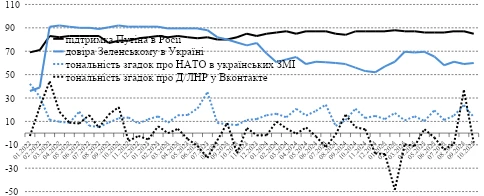 Sources: Levada Center, Kyiv International Institute of Sociology, sociological group Rating and corpus of political and media discourses about the war, created by the author.
 Moreover, the analysis of time periods indicates that the tonality of mentions of NATO in Ukrainian mass media affects the dynamics of Zelenskyi’s political capital, and the attitude towards Putin is related to the tonality of mentions of LPR and DPR by users of the VKontakte network.
That is, the concessions regarding NATO and Donbas have a personal dimension for the two leaders. Rejection of the prospect of NATO membership crosses out an important component of Zelensky’s political outlook and image. And Donbas has become an integral part of Putin’s political image, at least from the point of view of an average Russian.
Negotiations against the backdrop of a corruption scandal Operation “Midas” – the investigation of corruption in the energy sector – should be considered as another factor of negative expectations from the negotiations. The initial decision to involve politicians in the negotiations, whose involvement in corruption schemes cannot yet be ruled out, made Ukraine’s negotiating position vulnerable. This decision gave Putin an opportunity insist on the useful motives of those who sit on “golden pots”, and Trump on absence of cards in Ukrainians, not to mention the trump cards. At the same time, the power in Russia is built on the same people principles of charging for “market entry”scaled to all levels of the economy of this country.
Zelensky’s decision to release Andrii Yermak, one of the persons involved in the investigation, from the position of head of his Office and chief interlocutor after searches in the government quarter indicates a desire to avoid a negative corruption background during the negotiations.
With the exception of Yermak’s resignation, the impact of the corruption scandal on Ukraine’s domestic political agenda has so far been limited, judging by the analysis of changes in the media discourse.
Comparing the content of the five leading Ukrainian media (UP, League, RBC-Ukraine, ICTV and the opposition Strana) during the month before the disclosure of information about the Midas operation and ten days after it, only minor changes can be seen. Mentions of Zelensky significantly decreased (Cohen’s d effect size reached -1.47), but the balance of negative and positive statements about him remained. Only in UP publications, the positive tone of mentions of Zelenskyi significantly decreased (-1.01).

Twenty popular Ukrainian Telegram channels (from Trukha to Nikolaevskiy Vanko) began to mention Zelensky more often during the scandal, and mostly in a positive tone. There has already been such a rather unexpected reaction of Telegram channels to the scandal noticed earlier.
Unlike the Ukrainian media discourse, the Russian media discourse reacted to the corruption scandal faster and more lively. RosZMI (Izvestia, Pervy Kanal, Kommersant, Gazeta.ru, and the opposition Meduza) and the twenty most popular Russian Telegram channels (from Readovka to Sladkov+) began to mention Zelensky much more often.
Trump’s ultimatum on the start of negotiations drew attention to events in foreign policy, leaving the corruption scandal in the background. But, most likely, the reaction in Ukraine to the scandal should be seen not as weak, but as overdue.
First, the investigation is ongoing. Secondly, much will depend on the results of the negotiations. Acceptable results of the negotiations will make Zelenskyi’s positions less vulnerable to criticism. On the contrary, unacceptable results will increase the probability of turning those whom Zelensky entrusted to lead them, as well as himself, into scapegoats. They will ask for both corruption and diplomatic failures.
Avoid a crisis by being prepared for it The “Trump rule” of concluding agreements is not the only possible and certainly not the most optimal one. But it so happened that both the situation on the battlefield and the future of Ukraine depend on the philosophy and views of this politician. Therefore, whether you agree or disagree with it, being aware of the “Trump Rule” makes sense.
According to the “Trump rule”, the worst that can happen in the coming weeks is a course of corruption scandal, negotiations and political crisis.
The corruption scandal reduces the probability of reaching agreements acceptable to Ukraine in negotiations. In turn, the unacceptability of the content of the proposed agreement will leave the corruption scandal without a “diplomatic cover” and create the prerequisites for its transformation into an internal political crisis.
Trump is convinced that if you are prepared for the worst, “good will always take care of itself.” That is, preparedness for the worst does not negate the possibility of better scenarios. Thus, considering all possible scenarios, including the worst, is not “treason”. On the contrary, it gives an opportunity to be ready for a crisis that may be caused by a coincidence of circumstances. To avoid a crisis tomorrow, it is worth thinking about its possibility and appropriate actions today.
Anton Oliynyk
A column is a type of material that reflects exclusively the point of view of the author. It does not claim objectivity and comprehensive coverage of the topic in question. The point of view of the editors of “Economic Pravda” and “Ukrainian Pravda” may not coincide with the author’s point of view. The editors are not responsible for the reliability and interpretation of the given information and perform exclusively the role of a carrier.