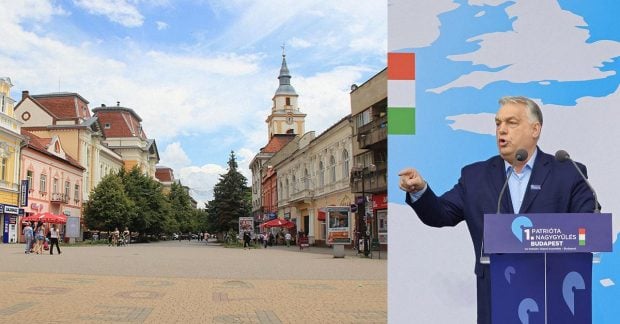
On April 12, polling stations for the Hungarian elections will be open in Ukraine, particularly in the town of Berehove, where a significant Hungarian community resides.
The right-wing populist party in Hungary has long sought the support of the Hungarian population in Berehove, aiming to secure their votes in upcoming elections. Reports indicate that this strategy appears to be effective.
A journalist visiting Berehove noted a stark contrast between the sentiments in this area and those in the rest of Ukraine, where many hope for the ousting of Viktor Orbán, a leader perceived as friendly to the Kremlin, who has held power for 16 years. However, the atmosphere in Berehove is more complex.
Local Support for Orbán
With a population of around 30,000, the majority in Berehove are ethnic Hungarians, and the Hungarian language is frequently heard alongside Ukrainian. In total, about 60,000 Hungarians live in the Transcarpathian region, and daily life remains closely linked to Hungary.
Some residents expressed their support for Orbán’s Fidesz party. One local, László, stated, “Orbán is not perfect, but he cares for Hungarians everywhere,” as he prepared to vote on Sunday.
László also voiced his disappointment over deteriorating relations between Hungary and Ukraine but praised Orbán for providing citizenship to ethnic Hungarians, financial aid, and protection of what he termed “language rights”. Budapest has established several polling stations in regional consulates, as many in Berehove hold dual Hungarian citizenship, despite its legal implications in Ukraine.
Orbán’s Stance on Transcarpathia
Orbán has long positioned himself as a defender of ethnic Hungarians abroad, claiming they face widespread discrimination in Ukraine and are forced to assimilate. Critics in both Hungary and Ukraine argue that he exaggerates grievances to justify his antagonistic stance towards Kyiv and its Western allies.
Residents of Berehove acknowledge the nuances of the situation. While some express concerns over Ukraine’s language policies affecting Hungarians, particularly a law that gradually reduces minority languages in schools, many argue that Orbán’s claims of discrimination are unfounded. Some likened the sentiments in Berehove to the divisions observed within Hungary itself.
Arthur, another local, remarked, “Just like in Hungary, there are people who want Orbán to win and those who wish for his opposition to take over,” expressing his desire for Orbán’s government to lose due to issues of corruption and its stance on Ukraine.
Community leaders and analysts have attempted to explain Orbán’s support in Transcarpathian towns and villages by noting that Berehove has historically been a border town, shifting between empires.
“For centuries, it was part of Hungary before becoming part of Czechoslovakia after World War I, briefly returning to Hungary before being incorporated into Soviet Ukraine in 1945 and finally becoming part of independent Ukraine in 1991. Regardless of governance, it has remained relatively poor and underdeveloped,” the article states.
Locals report that Orbán’s government has invested in schools, community centers, and agricultural support.
Tímur Tómbá, who leads the Hungarian community in Kyiv and is a vocal critic of the current government in Budapest, attributed Orbán’s popularity among Ukrainian Hungarians to state-controlled media in Hungary: “Most Hungarians in Ukraine still watch state propaganda. These people are fed lies from television.”
Transcarpathia Amidst the War
Orbán has also tapped into the complex sentiments arising from the ongoing war in the region. Located near the Hungarian border, Berehove might seem distant from the conflict: “The city has sent relatively few men to the front compared to other parts of Ukraine, and daily life is largely unaffected by air raid sirens or missile strikes.”
Orbán has accused Ukraine of sending ethnic Hungarians to the front lines and exaggerating their military losses.
However, Tómbá firmly opposed the notion that ethnic Hungarians are unwilling to serve Ukraine. He stated that since the full-scale invasion, several thousand individuals from Transcarpathia have fought in the Ukrainian armed forces, with about a hundred casualties. Like any other city, Berehove has a memorial in the central square honoring fallen Ukrainian soldiers.
Upcoming Hungarian Elections
As reported, Hungary’s parliamentary elections on April 12 could be pivotal for Prime Minister Viktor Orbán, who has held the position since 2010. Recent polls indicate that the opposition is significantly ahead of the ruling party.
In the lead-up to the elections, U.S. President Donald Trump has expressed support for the Hungarian government, promising American investments should Orbán remain in power.
Additionally, U.S. Vice President Jay D. Vance visited Budapest, where he publicly criticized the European Union, including its alleged interference in the Hungarian elections.
As Hungary prepares for its parliamentary elections on April 12, polling stations will also be set up in Ukraine's Berehove, home to a significant Hungarian community. The local sentiments towards Viktor Orbán's leadership are mixed, reflecting both support and criticism amidst complex historical ties and current geopolitical tensions.