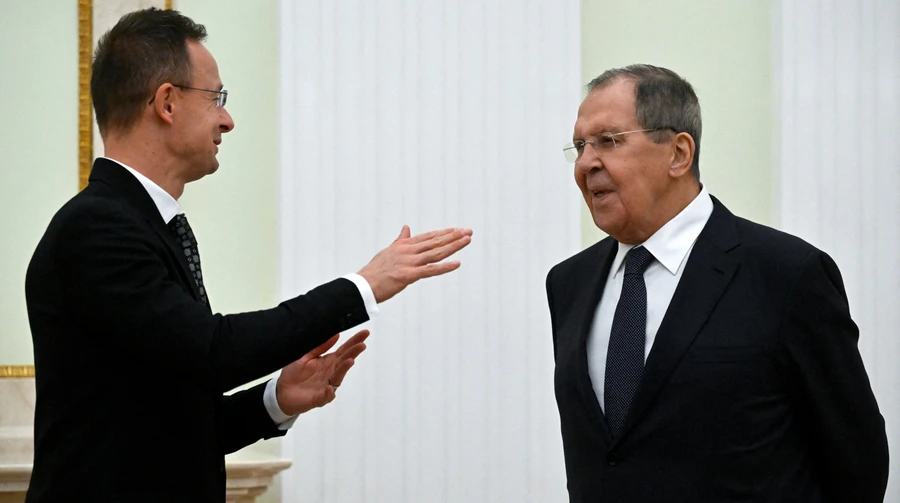
A recent investigation by the European journalism project Vsquare has unveiled details regarding Hungarian Foreign Minister Péter Szijjártó’s collaboration with Russia to obstruct Ukraine’s progress toward European Union membership. The findings, reported by “European Truth,” indicate that Szijjártó’s actions were part of a broader strategy coordinated with Russian officials.
The investigation includes transcripts of conversations between Szijjártó and Russian Foreign Minister Sergey Lavrov from 2023 to 2025. Multiple investigative outlets, including FRONTSTORY, Delfi Estonia, and The Insider, have verified the authenticity of these recordings.
In earlier reports, it was revealed that Szijjártó sought the removal of a relative of Russian oligarch Alisher Usmanov from the EU sanctions list at Lavrov’s request. Throughout various discussions, Szijjártó provided Lavrov with insights into expected European actions aimed at pressuring Russia, while also consulting on strategies that would undermine Ukraine and benefit Russian interests.
One notable instance occurred during the European Council summit on December 14, 2023, when leaders were set to decide on opening negotiations with Ukraine and Moldova. During breaks in the meetings, Szijjártó reportedly called Moscow to share Hungary’s strategy for exerting pressure. Ultimately, the plan did not succeed, as Hungarian Prime Minister Viktor Orbán left the summit to take a coffee break, leading to decisions being made without his input.
On July 2, 2024, following Orbán’s visit to Kyiv, Szijjártó immediately contacted Lavrov to discuss the contents of his conversation with Ukrainian President Volodymyr Zelenskyy. They also talked about organizing Orbán’s trip to Moscow ahead of a NATO summit in Washington, a visit kept secret from both the EU and NATO, which later drew criticism from European officials.
Szijjártó assured Lavrov that Orbán would attend as the leader of the EU presidency, despite lacking a mandate from the EU. This led to significant backlash from European officials who felt misled by Hungary’s actions.
In another conversation, Lavrov inquired about a document outlining the EU’s demands for Ukraine regarding minority language rights. Szijjártó responded that he could easily send it, despite the document being publicly available. An EU official noted that this request was peculiar, given the document’s accessibility.
On June 17, during a separate discussion, Szijjártó explained how Hungary was leveraging minority rights obligations to pressure Ukraine. Lavrov shifted the conversation to how this could be framed in the context of protecting Russian-speaking minorities, further complicating Ukraine’s path to European integration. Szijjártó assured Lavrov that this approach was consistent with European principles, stating, “Today it concerns your minority, but tomorrow it could be about ours.”
Szijjártó also mentioned coordinating with Slovak counterpart Juraj Blanár to block the EU’s 18th sanctions package.
Recently, details of a conversation between Hungarian Prime Minister Viktor Orbán and Russian President Vladimir Putin from fall 2025 were also leaked. European capitals sympathetic to Ukraine have expressed outrage over the revelations of coordination between Budapest and Moscow, deeming them a threat to European security.
An investigation reveals that Hungary's Foreign Minister Péter Szijjártó coordinated with Russia to obstruct Ukraine's EU accession efforts. The findings indicate a strategic partnership aimed at undermining European unity and security.