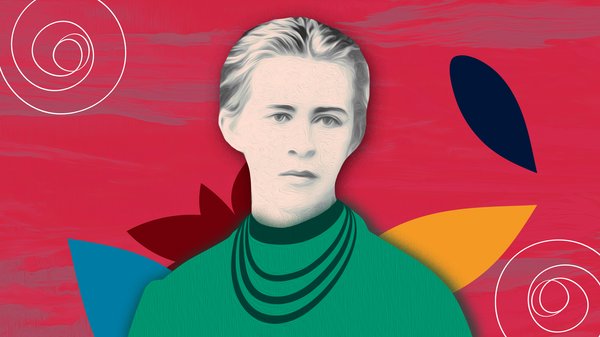
February 25 marks the 155th anniversary of the birth of Lesya Ukrainka, a prominent Ukrainian writer, translator, and cultural figure. Despite efforts by Soviet authorities to portray her as a fragile figure, her legacy is increasingly recognized as that of a significant intellectual and advocate for cultural diplomacy.
For many years, Ukrainka’s work remained relatively obscure in the Western world, despite the existence of English translations of her notable works, including “Forest Song” and “Cassandra.” These translations primarily circulated within diaspora communities, often presenting a simplified image of the author that overlooked her intellectual depth and modern themes.
Recent years have seen a shift in this perception, with Ukrainka gradually gaining recognition in Western cultural circles, not merely as an exotic author from Ukraine but as a thinker and playwright of global significance.
One of the key venues for promoting her work is the Ukrainian Institute in London, which facilitated a production of “Cassandra” in 2023, translated into English by poet Nina Murray. Writer Oksana Zabuzhko noted the relevance of the play, stating, “It took me ten years to convince European theater directors to stage ‘Cassandra.’ This is the most relevant drama of our time, deeply intertwined with aspects of contemporary conflict. Only now, thanks to the successes of the Ukrainian army, has the play reached European theaters.”
In 2022, the musical group Dakh Daughters presented a performance of “Forest Song” in France, directed by Lucy Berelovich, featuring French actors in the lead roles. The group described their approach as one that intertwined folklore with contemporary themes, creating a vibrant theatrical experience.
Despite these advancements, literary scholar Tamara Gundorova, author of the biography “Lesya Ukrainka: The Books of Sybilla,” pointed out that Ukrainka’s plays are still rarely performed in major theaters outside Ukraine. She emphasized the need for advocacy to bring her works to a global audience with pride.
Ukrainka’s growing popularity is also evident in academic circles. Gundorova has delivered lectures on her work at leading American universities, including Berkeley, Stanford, Princeton, and Harvard. She noted that for many professors and students, Ukrainka’s writings have been a revelation, resonating with contemporary discussions on topics such as women’s visibility in history and the social perception of illness.
The Ukrainian Research Institute at Harvard University has played a crucial role in promoting Ukrainka abroad by initiating a series of new English translations of her works. Recently, the English version of “The Blue Rose,” her first dramatic work, was published, along with “Cassandra,” featuring a foreword by Australian literary scholar Mark Pavlyshyn. A new translation of “Forest Song” is also forthcoming.
Interest in Ukrainka’s work extends beyond the English-speaking world. In 2021, “Forest Song” was translated into Azerbaijani for the first time, and two years later, the first Turkish edition of the play was released. Additionally, a collection of her works was published in Arabic to commemorate the 150th anniversary of her birth, including prose pieces that reflect her literary range.
Ukrainka’s legacy is commemorated globally, with monuments dedicated to her in cities such as Toronto, Saskatoon, Cleveland, Tbilisi, and Vienna. Recently, a square named after her was established in Grenoble, France.
As translations, academic courses, and theatrical initiatives continue to emerge, Lesya Ukrainka’s contributions to modern literature are increasingly entering the global intellectual discourse, a process that shows no signs of slowing.
Lesya Ukrainka's literary legacy is gaining recognition worldwide as her works are increasingly performed and studied in various cultural contexts. Recent translations and academic interest highlight her significance as a major figure in modern literature.