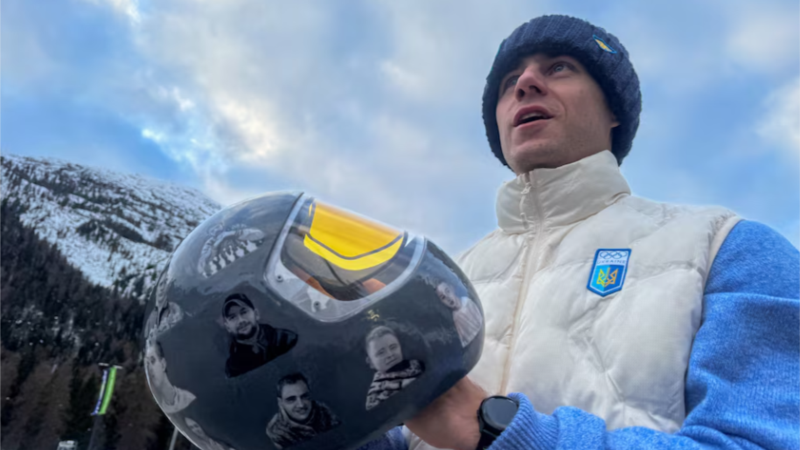
Ukrainian skeleton athlete Vladislav Geraskevych attended a Ukrainian luncheon during the Munich Security Conference on February 14, where he delivered a brief speech expressing gratitude for the support he has received.
In his remarks, Geraskevych highlighted the importance of unity surrounding Ukraine during challenging times. He stated, “I think that in these crazy times, with what I have dealt with in recent days, the brightest part has been the unity around Ukraine, and I hope we can maintain this for as long as possible: unity around Ukraine and the memory of those who sacrificed their lives. Thanks to this sacrifice, we can be at the Olympic Games today as Team Ukraine, and I am very grateful for that.”
Geraskevych also acknowledged the families of deceased athletes who have shown support for his initiative to wear a helmet featuring their portraits.
On February 12, the Court of Arbitration for Sport (CAS) rejected Geraskevych’s appeal against the International Bobsleigh and Skeleton Federation and the International Olympic Committee (IOC). The IOC had announced a ban on Geraskevych participating in the 2026 Winter Olympics, citing his refusal to adhere to rules regarding expressions of opinion, specifically his intention to wear a helmet adorned with images of fallen Ukrainian athletes.
Geraskevych maintains that wearing the “memory helmet” does not violate any regulations, asserting that his disqualification is unjust.
Currently, the XXV Winter Olympics are taking place in Italy, featuring thousands of athletes from numerous countries. Ukraine is represented by 46 athletes across 11 sports. Geraskevych’s disqualification occurred just hours before the start of the competitions due to his refusal to remove the helmet commemorating Ukrainian athletes who lost their lives during the ongoing conflict with Russia.
Ukrainian skeleton athlete Vladislav Geraskevych spoke at a luncheon during the Munich Security Conference, expressing gratitude for support amid his recent disqualification from the 2026 Winter Olympics. His ban stems from his intention to wear a helmet honoring deceased Ukrainian athletes, which the IOC deemed a breach of rules.
Source: Radio Free Europe/Radio Liberty