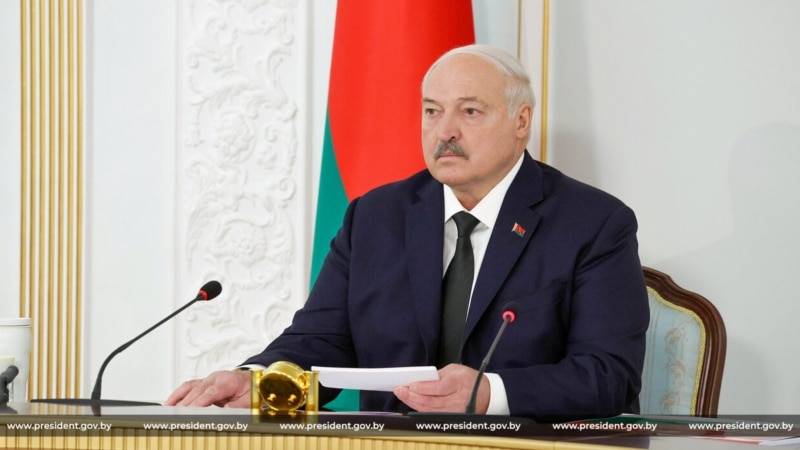
Ukrainian President Volodymyr Zelensky has signed a decree to implement sanctions against Belarusian leader Alexander Lukashenko, citing his support for Russia’s military aggression in Ukraine. The sanctions follow a decision by Ukraine’s National Security and Defense Council.
In a statement on Telegram, Zelensky detailed the military infrastructure established in Belarus, including the deployment of relay systems by Russian forces to enhance drone operations targeting Ukrainian regions. He noted that these systems have enabled strikes on critical infrastructure, including energy facilities and railways, which would not have been possible without Belarusian assistance.
Zelensky highlighted that over 3,000 Belarusian enterprises are reportedly contributing to the Russian war effort by supplying crucial military equipment and components. He specifically mentioned components used in missile production that threaten Ukrainian cities and towns. Furthermore, he pointed out ongoing developments to establish medium-range missile systems, which pose risks not only to Ukraine but also to European nations.
The President emphasized Ukraine’s commitment to working with international partners to ensure that the sanctions have a significant global impact. He accused Lukashenko of compromising Belarusian sovereignty in exchange for personal power, facilitating Russian evasion of global sanctions, and justifying the ongoing conflict.
The Ukrainian presidential office also accused Lukashenko of facilitating the forced deportation of Ukrainian children to Russia. It was noted that sanctions against Lukashenko have already been imposed by the European Union, the United States, Japan, Canada, Switzerland, and New Zealand due to systematic human rights violations and support for Russian aggression.
Vladislav Vlasuk, an advisor to the President on sanctions policy, remarked on the ongoing involvement of Belarusian companies in circumventing EU sanctions, including the supply of components and logistical support. He called for a harmonization of the sanctions regime against Belarus with that imposed on Russia.
As of now, Lukashenko has not publicly commented on Ukraine’s decision. His regime continues to conduct military exercises amid escalating tensions with the West and the ongoing war in Ukraine, where Belarus has provided logistical support to Russian forces. Although Belarus is not directly engaged in the conflict, it has allowed Russian troops to operate from its territory, facilitating attacks on Ukraine.
In contrast to the current U.S. administration, both EU and Ukrainian authorities do not recognize Lukashenko as a legitimate leader of Belarus. While there are de facto relations between the EU and Belarusian authorities, active political dialogue remains absent. In previous years, representatives of the Trump administration engaged with Lukashenko, including discussions about Belarus’s potential role in international peace initiatives.
Ukrainian President Volodymyr Zelensky has enacted sanctions against Belarusian leader Alexander Lukashenko for his military support to Russia. The sanctions aim to address the involvement of Belarusian enterprises in supplying military resources critical to the ongoing conflict in Ukraine.