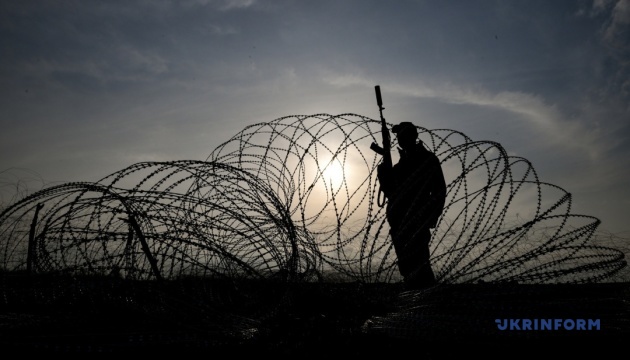
Military personnel from the 141st Separate Mechanized Brigade report that logistical losses due to enemy drones are currently surpassing those experienced on the front lines. This shift reflects a significant change in the nature of warfare over the past four years.
Recent intelligence indicates that the enemy is preparing for offensive operations in certain areas, evidenced by troop movements and an increase in both equipment and personnel. The battlefield landscape has evolved, with enemy drones such as “Orlans,” “Zalis,” and “Molnias” becoming more prevalent, complicating aerial control.
Journalists from Ukrinform recently visited a unit of the 141st Brigade, where accessing military positions has become increasingly challenging. The terrain, muddy from recent rains, poses difficulties for heavy vehicles, requiring skilled navigation to avoid becoming stuck.
Upon arrival at the Novopavlivsk direction, the team met with Commander Roman Zhuchok, known by his call sign “Cowboy.” He explained that their brigade is currently focused on defensive actions, as their area of responsibility has expanded. “We are holding the line while our assault units advance towards Huliaipole, reclaiming lost positions,” he stated.
Zhuchok noted a marked increase in enemy reconnaissance efforts, with the presence of foot patrols attempting to breach their defenses. He highlighted that drone activity has intensified, with daily counts of approximately 60 FPV drones and 40-50 “Molnias” observed in their operational zone.
“The enemy is attempting to disrupt our logistics to prepare for further offensive actions,” he explained. “When they transition to defense, they must commit reserves, which limits their offensive capabilities. Meanwhile, they are bolstering their forces in anticipation of an attack.”
The commander emphasized that the presence of the Russian drone unit “Rubikon” has significantly impacted operational dynamics. Increased drone activity has made logistical operations, such as personnel rotation and ammunition supply, more complex. The concept of a clear front line is fading, as both sides operate within a “grey zone” of approximately 20 kilometers, complicating military logistics.
During the visit, the team witnessed the dangers posed by enemy drones firsthand. An enemy “Molnia” flew overhead, followed by an explosion nearby, illustrating the constant threat they pose.
“There are so many drones, it’s like the subway in Kyiv, with one passing every ten minutes,” joked a soldier with the call sign “Deputat.” He is responsible for logistics, including personnel replacements and ammunition supply. He noted the importance of firsthand observation to effectively respond to battlefield changes.
“We work with 155 mm caliber artillery, which requires heavier vehicles for transport. Proper planning is essential to navigate the terrain successfully,” he added.
However, access to certain areas has been severely restricted, with some units unable to reach their destinations for over a week due to drone activity. “The enemy is focused on expanding their operations in this direction. If we analyze our past mistakes and adjust our strategies accordingly, we can improve our outcomes,” he stated.
Tragically, the brigade recently lost a comrade, a young soldier known by the call sign “Obama,” due to an FPV drone attack. The circumstances surrounding the recovery of his body were fraught with danger, as enemy drones monitored the area.
“Retrieving his body was a complex operation, but we managed to do so despite the risks involved,” said “Deputat.” He reflected on the brigade’s motto, “One for all,” emphasizing the commitment to supporting one another.
Despite the challenges, the soldiers remain focused on their duties. They noted that the enemy’s drone capabilities have increased significantly, making the current operational environment more hazardous than in previous years.
“The situation is about 70% more challenging now than it was a few years ago due to the proliferation of drones,” said another soldier, known as “Kazhan.” He recounted experiences from previous operations, noting that the current level of drone activity complicates maneuverability and increases risks during nighttime operations.
As the brigade continues its operations, they are adapting to the evolving nature of warfare, learning to analyze enemy patterns and improve their logistical strategies. The artillery unit, equipped with M-114 howitzers, has achieved notable success, firing 554 rounds in 34 days while maintaining operational security.
“Artillery plays a crucial role in halting enemy advances. We have a significant amount of work to do,” the soldiers concluded, emphasizing the need for continuous adaptation and analysis in their ongoing efforts.
The 141st Separate Mechanized Brigade in Eastern Ukraine is facing increased logistical challenges due to heightened enemy drone activity, which is impacting both operational strategies and battlefield dynamics. The unit's leadership emphasizes the need for adaptation and careful planning in response to evolving threats.
Source: Ukrinform
