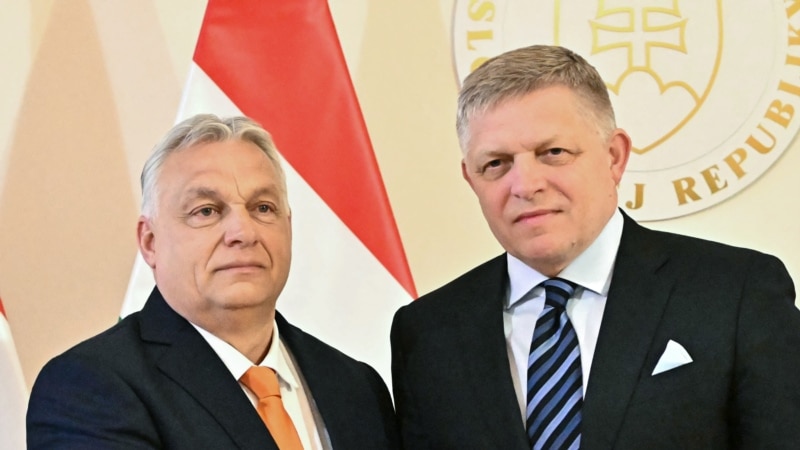
Hungarian Prime Minister Viktor Orbán announced plans to investigate the condition of the Druzhba pipeline, which has been a key route for transporting Russian oil to Hungary and Slovakia. Following discussions with Slovak Prime Minister Robert Fico, Orbán expressed the need for a joint Hungarian-Slovak commission to assess the pipeline’s status and urged Ukrainian President Volodymyr Zelensky to grant access to inspectors.
In a statement on February 27, Orbán criticized Kyiv for allegedly blocking the Druzhba pipeline and called for greater respect for Hungary’s interests. This statement followed an open letter and video message he shared the previous day, where he reiterated his concerns about the situation.
Both Hungary and Slovakia have been holding up the approval of the 20th sanctions package against Russia, as well as a multi-billion euro loan for Ukraine, which was agreed upon at a recent EU summit. The two nations have vowed to maintain their veto until the transportation of Russian crude oil via the Druzhba pipeline is restored.
Ukrainian officials contend that the pipeline was damaged due to Russian shelling in late January, a claim that Hungarian and Slovak authorities dispute. On February 23, the European Commission confirmed that Russia had indeed damaged the Druzhba pipeline but also noted Ukraine’s obligation to repair it, with timelines dependent on Ukrainian actions.
Since the onset of the full-scale invasion, the EU has prohibited the purchase of Russian oil. However, Hungary, Slovakia, and Austria were granted extensions due to their lack of access to maritime routes, which limits their ability to receive oil from other countries and increases their reliance on the Druzhba pipeline.
The Druzhba pipeline, which runs through Ukraine, is crucial for transporting Russian oil to Europe, particularly to Hungary and Slovakia. A study by the Finnish Center for Research on Energy and Clean Air (CREA) and the Bulgarian Center for the Study of Democracy (CSD) revealed that imports of Russian crude oil to Hungary and Slovakia from 2022 to 2024 generated €5.4 billion in revenue for the Kremlin, equivalent to the cost of 1,800 Iskander-M ballistic missiles.
Hungarian and Slovak leaders are pushing for an investigation into the Druzhba pipeline's condition, citing concerns over its operation amid ongoing geopolitical tensions. Both countries are leveraging their positions in negotiations over sanctions against Russia and financial aid to Ukraine, highlighting the complex interdependencies in energy supply and international relations.