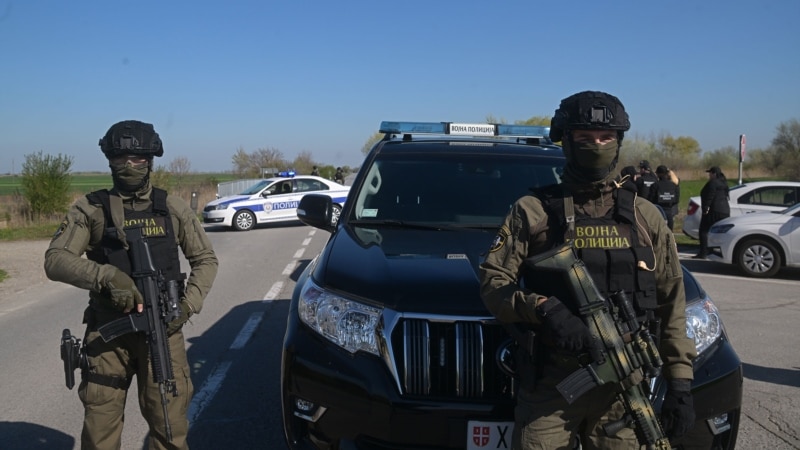
The director of Serbia’s Military Security Agency, Djuro Jovanic, has dismissed allegations linking Ukraine to the discovery of explosives near a gas pipeline that transports Russian gas to Hungary. Jovanic stated that the evidence clearly indicates the explosives were made in the United States, questioning the rationale behind suggesting that Ukraine would benefit from such an act.
He confirmed that an investigation is ongoing and that further information will be released in due course. Jovanic also revealed that his agency had warned Serbian political leaders for months about potential threats to the gas infrastructure, but these warnings were met with skepticism.
Following an emergency meeting of Hungary’s Defense Council, Prime Minister Viktor Orban refrained from directly blaming Ukraine but noted that Kyiv has long sought to sever Europe’s ties to Russian energy supplies. Meanwhile, Kremlin spokesperson Dmitry Peskov commented that there is currently no evidence identifying those responsible for the attempted attack, although he hinted at possible Ukrainian involvement.
The Ukrainian Foreign Ministry has firmly rejected any claims of its involvement in the incident, calling such assertions unfounded. Spokesperson Georgiy Tikhiy emphasized that Ukraine is not connected to the explosives found near the Turkish Stream pipeline, suggesting instead that it could be a Russian operation aimed at influencing Hungary’s elections.
On April 6, Orban inspected part of the Turkish Stream pipeline at the Hungary-Serbia border, describing the situation as “extremely serious.” He assured that Hungary’s gas supply is not currently at risk but urged caution, stating, “Yesterday, they attempted to blow up the pipeline. We are checking the situation on our side.” Orban warned that any disruption to this pipeline would severely impact the Hungarian economy.
On April 5, Serbian President Aleksandar Vucic announced that explosives had been found during an investigation into threats against the gas infrastructure connecting Serbia and Hungary. He reported that two large packages of explosives were discovered in backpacks near the village of Velebit, posing a significant risk to both nations’ gas supply.
Vucic indicated that authorities believe they know the group behind the attempted detonation, suggesting a political motive behind the act. However, he did not specify who might be responsible.
The incident comes at a politically sensitive time in Hungary, as recent polls indicate that Orban may face challenges in the upcoming parliamentary elections scheduled for April 12. Opposition leader Peter Magyar expressed skepticism about the incident, suggesting it may be a tactic to boost Orban’s electoral chances.
In response to these claims, Orban reiterated that the incident is a matter of energy security rather than electoral politics. He stated, “This event does not affect the elections, but rather Hungary’s energy security. Let’s not confuse the campaign with governance.”
Relations between Ukraine and Hungary have soured recently, particularly after Budapest accused Ukraine of delaying repairs to the Druzhba oil pipeline, which was damaged by Russian strikes. This pipeline is crucial for transporting oil from Russia to Hungary and Slovakia.
Both Slovakia and Hungary are blocking the approval of a 20th sanctions package against Russia and a multi-billion euro loan for Ukraine, insisting that the flow of Russian resources through the Druzhba pipeline must resume first.
As Hungary approaches its parliamentary elections on April 12, the political landscape remains uncertain, with some polls indicating a slight lead for opposition parties over Orban’s ruling Fidesz party. Reports have emerged suggesting that Russia is deploying political strategists to aid Orban’s re-election efforts.
Serbia's Military Security Agency has refuted claims of Ukrainian involvement in a bomb incident near a gas pipeline. The situation unfolds amid heightened political tensions in Hungary as elections approach, with implications for energy security in the region.