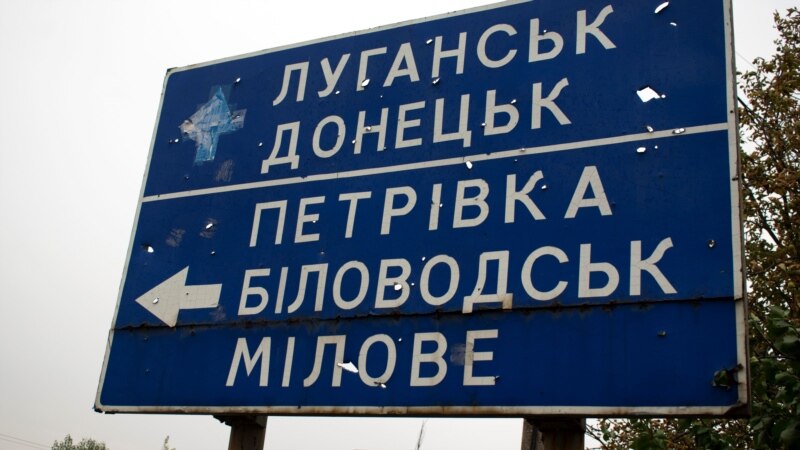
The American Institute for the Study of War (ISW) has challenged recent assertions from the Kremlin regarding the complete capture of Ukraine’s Luhansk region, describing these claims as exaggerated in light of minor changes on the battlefield. This marks the third instance since the onset of the full-scale invasion in February 2022 that the Russian Ministry of Defense has declared full control over the area.
According to ISW, as of April 1, Russian forces reportedly control 99.84% of Luhansk, with the exception of the settlements of Nadiya and Novoiehorivka, both located east of Borova. The institute suggests that these overstated claims are part of a coordinated information campaign aimed at creating a false sense of urgency, pressuring Ukraine to concede unoccupied territories in the Donetsk region.
ISW’s report indicates that the Kremlin’s statements are designed to portray Ukrainian defenses as nearing collapse, potentially influencing the United States and its allies to compel Ukraine into unwarranted territorial concessions. The report also highlights that significant Russian military gains are unlikely in the medium term, particularly against well-fortified Ukrainian cities in Donetsk.
Furthermore, analysts have dismissed Russian officials’ assertions that Russian troops could easily seize the remainder of Donetsk. They describe such claims as unrealistic and disconnected from the current realities of warfare. The report emphasizes that recent Ukrainian successes demonstrate that substantial Russian advances on the battlefield are not guaranteed.
Since the beginning of 2026, the pace of Russian military advances has reportedly slowed, with Ukrainian forces maintaining the initiative and successfully conducting counterattacks in various sectors along the front line. The ISW notes that despite controlling much of Luhansk for years, Russian forces have not launched a successful offensive towards Sloviansk or Izyum from the east or northeast.
On March 31, Ukrainian President Volodymyr Zelenskyy revealed that Russia is demanding Ukraine withdraw its troops from Donetsk within two months as part of negotiations. He stated, “They claim that within two months they will capture eastern Ukraine and the Donbas. If Ukraine does not comply, they will take Donbas and then impose further conditions.”
On April 1, Kremlin spokesperson Dmitry Peskov stated that Zelenskyy must decide today to withdraw Ukrainian forces from Donbas, asserting that such a move could halt the active phase of the conflict.
In a statement on the same day, the Russian Ministry of Defense claimed that its armed forces had completed the occupation of the Luhansk region, which Moscow refers to as the “Luhansk People’s Republic.” However, the Third Assault Brigade of Ukraine officially refuted this claim, stating that Ukrainian forces continue to hold the last strongholds in the region. Their Telegram announcement indicated that troops are defending Nadiya, Novoiehorivka, and Hrekivka against all attempts by Russian forces to secure the area through military and disinformation tactics.
The General Staff of Ukraine’s Armed Forces confirmed that defensive positions in Luhansk are being maintained. In October 2025, President Vladimir Putin claimed that Russian troops needed to capture only 0.13% of Luhansk’s territory.
According to the Luhansk Regional Military Administration, as of January 2025, over 95% of the region was under temporary Russian occupation, a figure reiterated in July 2025.
The full-scale invasion of Ukraine commenced on February 24, 2022, involving attacks across the entire border, including an incursion into Kyiv from Belarus. Russian forces also occupied parts of the Zaporizhzhia and Kherson regions in the south.
President Putin has characterized the invasion as a “special military operation,” initially aimed at “demilitarization and denazification,” later shifting to the “protection of Donbas.” In September and early October, Russia attempted to annex parts of the occupied Zaporizhzhia, Kherson, Donetsk, and Luhansk regions, actions deemed illegal by Ukraine and the West. On October 12, the UN General Assembly passed a resolution condemning Russia’s annexation attempts.
The ISW has questioned the Kremlin's claims of full control over Luhansk, asserting they exaggerate minor battlefield changes. Analysts emphasize that Russian military advancements are unlikely, particularly against fortified Ukrainian positions.