“The publication emphasizes that tough foreign policy should be conducted outside the EU.”, — write: www.unian.ua
The publication emphasizes that tough foreign policy should be conducted outside the EU.
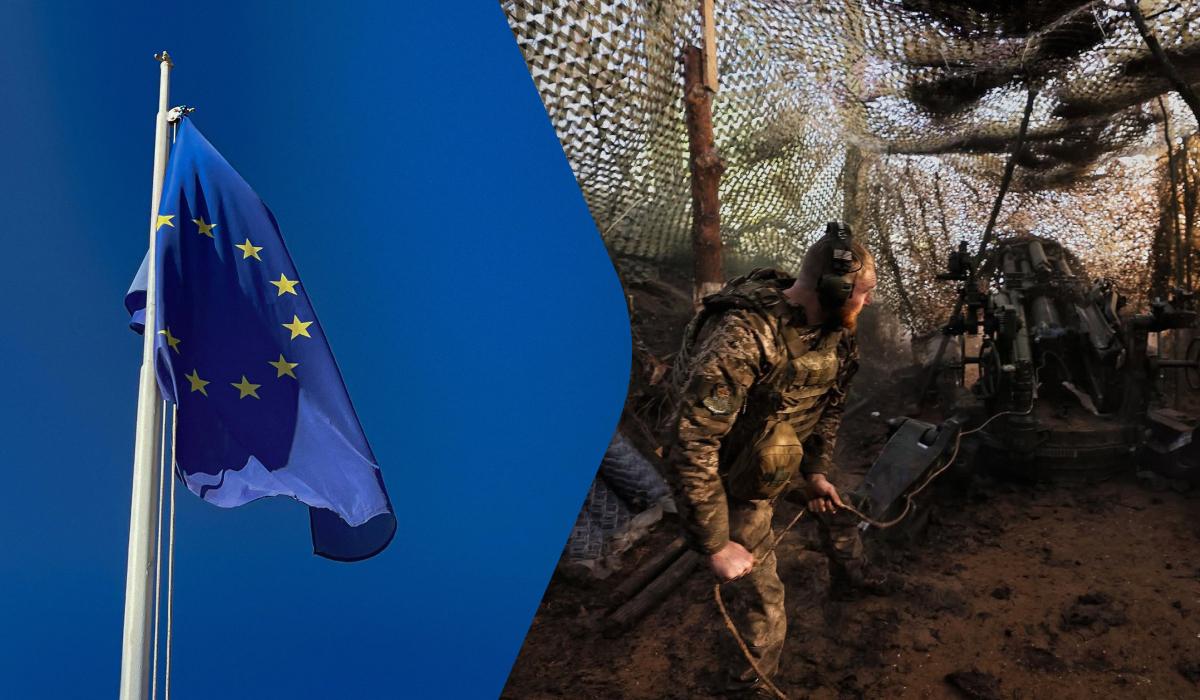 According to the reviewer of the publication, in the case of Ukraine, Europe should not allow the scenario of 1939 to repeat itself / UNIAN collage, photo pexels, artillery division, 33rd Ukrainian Armed ForcesIn the late summer of 1939, the foreign ministers of the USSR and Germany, Vyacheslav Molotov and Joachim von Ribbentrop, signed the infamous Non-Aggression Pact, which divided Eastern Europe between their countries and allowed Hitler to invade Poland just days later. At the same time, the now proposed American-Russian plan to end the war in Ukraine shows that the major military powers have once again conspired to divide the continent for their own benefit. Bloomberg columnist Mark Champion expressed this opinion.
“This should have been clear a long time ago. At least since February, I said that the Trump administration was interested not so much in concluding a peace agreement for Ukraine, but in restarting relations between the United States and Russia at the expense of Kyiv and its European allies. The publication of the 28-point American-Russian proposal made it impossible to ignore,” the author of the article noted.
According to Champion, now that European leaders have finally admitted that they are alone in the Ukraine issue, the question arises: can the European Union become a geopolitical player capable of standing up to Russia, China and its nominal ally the United States. The observer believes that the honest answer to this question will be “no”.
“That would require a show of considerable force, which is simply not in the bloc’s DNA. The European project was designed so that its members would never again fight each other, as they did during two catastrophic conflicts and for centuries before. The EU did so well at this task that it won the Nobel Peace Prize in 2012. But when it comes to protecting against external threats, the path to the modern EU is littered with failed joint projects in the field security, starting with the Western European Union in 1954, and even earlier. This task was quickly transferred to the North Atlantic Treaty Organization, that is, the United States, and it has remained so to this day,” the author of the publication explained.
In particular, the head of the Department of Modern History at the Ludwig Maximilian University of Germany, Kieran Klaus Patel, noted that asking the EU to show hard power is like “telling a professional football player that from now on he will play rugby.”
According to Champion, the EU’s unpreparedness for the world of “geopolitical rugby” has no clear institutional solution. However, Europe has no other choice but to make a connection if it does not want to be “torn into pieces”.
“The key is to make Europe – not the EU – the driving force of diplomacy and the projection of hard power. Tough foreign policy should be conducted outside the EU, if possible within NATO, and if this is not possible – with the help of specially created coalitions,” the observer added.
The author of the material believes that to some extent it has already begun. Great Britain became the head of the Joint Expeditionary Force of 10 Nordic countries that are not part of the EU and NATO, and another group unites the so-called North Baltic Eight. Also recently, Great Britain and France organized a coalition of volunteers for a peacekeeping mission in Ukraine.
“It’s chaotic, but I’m not sure it’s a bad thing,” said Niklas Helvig, a leading researcher at the Helsinki-based Finnish Institute of International Affairs.
Champion added that this may also be the only way for Europe to act effectively, because too many geopolitically important players in the region, including NATO members Norway, Great Britain and Turkey, are not part of the EU.
“As they often say, Europe is returning to history after several decades of utopian respite, so its first priority is rearmament. But Europe has always united against external threats only when they were perceived as common and extraordinary, obvious examples of which are the Soviet Union during the Cold War and the Ottoman Empire at the end of the 17th century,” the observer reminded.
The Champion also concluded:
“Finding a way to do both – keep the peace at home while projecting strength abroad – may be the most important challenge facing European leaders since responding to the fateful Russo-German ‘peace’ agreement of 1939.”
Europe and the war in Ukraine – the latest newsEarlier, the New York Post wrote that aid to Ukraine would cost Europe half as much as concessions to Russia. In particular, the financing of Ukraine’s military actions for four years will cost European governments 606-972 billion dollars. At the same time, strengthening the eastern flank of Europe, if Moscow gets its way, will cost it almost twice as much – from 1.4 to 1.8 trillion dollars.
At the same time, Bloomberg wrote that Europe is preparing to repel the invasion of the Russian Federation without the help of the United States. Investments are currently being made in Europe’s arms industry, and military exercises are now taking place without the participation of the Americans.
“The urgency of these preparations will be underscored this week as Washington deepens ties with Russia. While the White House is pushing for an end to the war in Ukraine, its threats this month to end military support for Kyiv have raised the possibility that European nations will have to defend Ukraine, and perhaps even the rest of their eastern border, with limited U.S. support,” the newspaper added.
You may also be interested in news:
- Macron will ask Xi Jinping to influence the Russian Federation to end the war in Ukraine, – BFM
- The Italian government has officially approved the 12th military aid package for Ukraine
- In South Africa, a radio presenter and a number of other people are suspected of recruiting men into the Russian army